Most of us don’t have time to watch markets all day.
We have jobs. Businesses. Families. A lawn that keeps growing back.
So we do the sensible thing: we hand our money to a professional, put it in an investment fund, and get on with life.
But before you hand anything over, there’s one question many investors skip — and it quietly decides how your money is priced, what the fund can buy, and how easily you can get it back:
When you want out, who gives you the cash?
That single question splits funds into two families: open-ended funds and closed-end funds. Here’s a simple guide to open-ended vs closed-end funds — no jargon required.

First, what is an investment fund?
An investment fund pools money from many investors and gives it to a professional manager, who invests it according to a stated mandate — for example Australian large-cap shares, government bonds, or a mix of both.
Each investor owns a slice of the fund, called units (or shares). Each unit is worth the fund’s net asset value (NAV) per unit — the value of everything the fund owns, minus its liabilities and expenses, divided by the number of units.
In Australia, most everyday managed funds are set up as unit trusts.
The most important design choice in any fund is not the logo or the glossy brochure. It’s how investors get in and out. That choice shapes much of what follows.
Open-ended funds: the fund always buys you back
An open-ended fund has no fixed size. It creates new units when investors put money in and cancels units when they take money out — usually at NAV, which is typically calculated once each dealing day.
You’ll hear different names depending on where you are: a “mutual fund” in the US, a “unit trust” or OEIC in the UK and much of Asia, and an unlisted managed fund in Australia.
Units are not traded on a stock exchange. You deal directly with the fund manager (or through a platform or distributor).
Think of it like a club with only one door.
You come in through the door. You leave through the same door. And the club itself has to hand you your cash on the way out.
Because the fund must be able to pay cash on demand, it usually holds liquid assets: listed shares, government and corporate bonds, and money-market instruments.
How redemption works
- You place a redemption request before the fund’s daily cut-off time.
- Your units are handed back and cancelled.
- You receive that day’s NAV — but you only learn the exact price after it is struck.
- Cash usually arrives a few business days later, often between T+2 and T+5 (T being the dealing day). Always check the fund’s Product Disclosure Statement (PDS).
The manager pays you from the fund’s cash buffer, or by selling assets.
And here’s the catch.
When lots of investors want out at the same time — usually in a sell-off — the manager may have to sell into a falling market. In severe conditions, some funds can even delay or pause withdrawals.
Selling to meet redemptions can also realise capital gains inside the fund, which are passed on to the investors who stayed. Yes, you can receive a tax bill because someone else left.
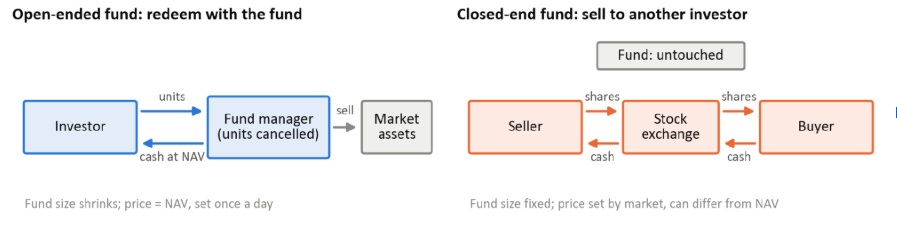
Figure 1. How an investor exits. Open-ended: units go back to the fund, which pays cash at NAV. Closed-end: shares are sold to another investor on the exchange, and the fund’s capital is unchanged.

Closed-end funds: you sell to the next person in line
A closed-end fund raises a set amount of capital upfront, usually through an initial public offering (IPO), then lists its shares on a stock exchange. To exit, you sell to another investor at the market price — the fund itself is not part of the trade.
Think of it like concert tickets.
There’s a fixed number of seats. If you can’t make it, the venue won’t refund you. You resell your ticket to someone else — and the price depends on how badly they want to go.
In Australia, closed-end funds are mostly listed investment companies (LICs) and listed investment trusts (LITs) on the ASX. They can still raise more money later or buy back shares, but day-to-day, investors trade existing shares with each other.
Because the manager never has to sell assets to pay out a departing investor, the capital is effectively permanent. That is why closed-end funds can hold illiquid assets: real estate, infrastructure, private equity, unlisted companies, or small-cap and frontier-market shares. Many also use modest borrowing.
How exit works
- You sell your shares through a broker during trading hours.
- Settlement follows the exchange’s normal cycle — usually two business days (T+2).
- The fund’s share count and portfolio stay the same.
The trade-off is the price.
It’s set by supply and demand, not NAV. So shares often trade at a discount (below the value of the assets) or a premium (above it). In Australia, LICs and LITs report this value as net tangible assets (NTA) per share.
Your shares can fall even when the underlying assets haven’t — simply because a discount widened.
On the other hand, the portfolio itself is shielded from the daily rush of investors coming and going.
Not sure which structure suits you?
Start with a free Financial Health Check™ — a simple way to see where you stand before any advice is given.
The special case: exchange-traded funds (ETFs)
An exchange-traded fund (ETF) sits between the two: its size changes like an open-ended fund, but it trades on a stock exchange like a closed-end fund.
Back to the concert. Imagine the venue can add or remove seats overnight through a handful of large ticket agents — so resale prices never drift far from face value.
That’s roughly how an ETF works. Large institutions (authorised participants and market makers) create and redeem ETF units with the fund, which keeps the market price close to NAV.
Most ETFs track an index — for example, the S&P/ASX 200 in Australia or the VN30 in Vietnam. (If you’ve read The Theory of Stock Investing, you already know why that simple formula is so hard to beat.)
We’ll cover ETFs in detail in a separate article.
Open-ended vs closed-end funds vs ETFs: side by side
| Open-ended fund | Closed-end fund | ETF | |
|---|---|---|---|
| Fund size | Variable – units created and cancelled daily | Fixed after IPO (can raise more or buy back later) | Variable – via creation and redemption |
| How you exit | Redeem with the fund | Sell to another investor on the exchange | Sell on the exchange; large institutions redeem with the fund |
| Price you receive | NAV, once per dealing day | Market price – premium or discount to NAV | Market price, usually close to NAV |
| When you can trade | Dealing days only, before cut-off | Whenever the exchange is open | Whenever the exchange is open |
| Cash settlement | Often T+2 to T+5 after dealing day | Exchange cycle (usually T+2) | Exchange cycle (usually T+2) |
| Gains realised inside the fund | Possible, when the fund sells to meet redemptions | Not from investor exits | Usually fewer – redemptions handled by large institutions, often in kind |
| Listed on an exchange? | No – via manager, platform or distributor | Yes | Yes |
| Typical assets | Liquid: listed shares, bonds, money market | Can hold illiquid assets; may use borrowing | Mostly liquid; often index-tracking |
Key takeaways
- The exit route shapes much of the rest. Open-ended funds buy your units back at NAV. Closed-end funds are sold to another investor at whatever the market will pay.
- The assets follow the liquidity. Open-ended funds need liquid assets to meet redemptions. Closed-end funds’ permanent capital suits illiquid, long-horizon strategies.
- Each comes with its own trade-off. Open-ended funds usually redeem at NAV, but settle in days, can delay withdrawals and can pass on taxable gains to remaining investors. Closed-end funds trade during the day, but your exit price may sit well below the value of the assets.

Where this leaves you as an investor
In the open-ended vs closed-end funds debate, neither structure is “better”. They are built for different jobs.
If you may need your money back at a fair, predictable price, the structure behind a fund matters as much as what it invests in. If you’re comfortable riding out market prices for access to assets you couldn’t otherwise reach, a listed structure may play a different role.
Working out how these fit with your goals, timeframe and other assets is a question to take to a licensed financial adviser before you change anything. Our Sydney financial planner comparison guide lists the questions worth asking before you choose one.
Frequently asked questions
What is the main difference between open-ended and closed-end funds?
The difference is how you exit. In an open-ended fund, you redeem your units directly with the fund at net asset value (NAV). In a closed-end fund, you sell your shares to another investor on a stock exchange at the market price, which can be above or below NAV.
Is a managed fund open-ended or closed-end?
Most unlisted managed funds in Australia are open-ended unit trusts: you apply and redeem directly with the fund manager or through a platform. Listed investment companies (LICs) and listed investment trusts (LITs) on the ASX are closed-end.
Why do closed-end funds trade at a discount to NAV?
Closed-end fund prices are set by supply and demand on the exchange, not by the value of the underlying assets. If more investors want to sell than buy, the share price can fall below NAV (or NTA) even when the assets themselves have not changed in value.
Is an ETF an open-ended or closed-end fund?
An ETF is a hybrid. Its size changes like an open-ended fund because units are created and redeemed by large institutions, but it trades on a stock exchange like a closed-end fund. This mechanism usually keeps its price close to NAV.
How long does it take to get money out of an open-ended fund?
You place a redemption request before the daily cut-off and receive that day’s NAV. Cash usually arrives a few business days later, often between T+2 and T+5, depending on the fund. The PDS sets out the exact terms, including when withdrawals can be delayed.
Next step
Not sure how these funds fit your plan?
We can look at how your investments fit your timeframe, income needs and other assets, before any change is made.
Start with a free Financial Health Check™
General information only. Personal advice requires an agreed scope and may need a Statement of Advice (SOA) or Record of Advice (ROA). Fees are agreed in writing before you start.
Tax, superannuation, and regulatory information in this article is based on legislation and ATO/ASIC guidance current as of 2026. These rules are complex and subject to change, and this article is not updated retrospectively when they do. This information is a general summary only and should not be relied upon as formal tax advice — always confirm current rules with a registered tax agent or the ATO directly.
General Advice Warning: This information is general in nature only and does not constitute personal financial, legal, or tax advice. It has been prepared without taking into account your individual objectives, financial situation, or needs. Before acting on any information, you should consider its appropriateness having regard to your objectives, financial situation, and needs, and seek professional advice from a licensed financial adviser and registered tax agent. Past performance is not a reliable indicator of future performance.
This information is provided by Infinite Zephyr & Wealth Pty Ltd (ABN 12 628 624 279), an Authorised Representative (AR 001268024) of NDT Capital Pty Ltd (AFSL 558899). You can verify this authorisation on the ASIC Financial Advisers Register. For dispute resolution, contact the Australian Financial Complaints Authority (AFCA).