Australian tax treatment distinguishes receiving an inherited asset from later disposing of it, when capital gains tax (CGT) may apply unless an exemption is available. If you receive a super death benefit, its tax treatment may depend on your dependency status under tax law. Inheritance financial advice connects these tax questions with debts, access to money and longer-term goals.
The framework starts with your records, connects them to the relevant tax and access questions, then moves to decisions about debts and longer-term goals. Your inherited-asset records matter because the cost base used for a later sale may depend on the deceased’s acquisition history or the asset’s market value at death.
Key takeaways
- Receiving an inherited asset and selling it later are different events for capital gains tax.
- Eligibility to receive a super death benefit does not automatically mean the payment is tax-free.
- Offset accounts and redraw facilities have different access arrangements.
- Acquisition records and valuations may affect an inherited asset’s cost base; super death benefits can have tax-free and taxable components.
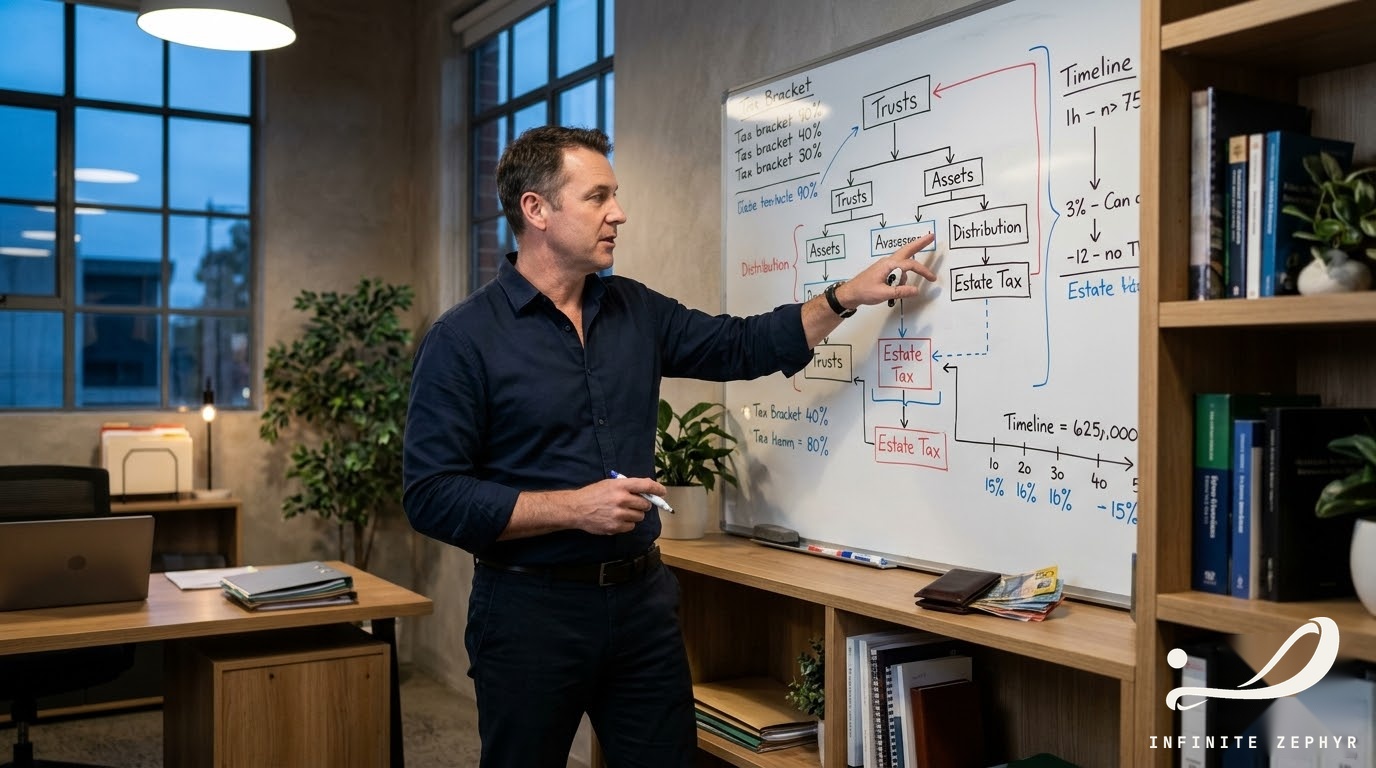
What Comes First With Inheritance Financial Advice?
Inheritance financial advice starts with identifying the assets involved, their distribution status and the records available. Cash, property, shares and super payments each bring different questions about tax and access to money. Existing debts and near-term cash needs help define which decisions require attention before longer-term goals are considered.
An inheritance records checklist
The first task is to establish what you are receiving, whether it has been distributed and which records accompany it. The checklist connects each record to a question about tax, access to money or advice scope.
- Advice documents: check registration, authorised advice areas and the Financial Services Guide before engagement.
- Assets and debts: record cash, property, shares and super benefits, alongside existing debts and near-term cash needs.
- Acquisition history: gather the deceased’s purchase dates, acquisition costs and relevant expenses incurred by the beneficiary or estate’s legal personal representative.
- Valuations: for assets acquired before 20 September 1985, identify a date-of-death valuation; for later acquisitions, locate cost-base records, subject to applicable exceptions.
- Inherited dwelling: record ownership history, residence and rental use, the date of death and any proposed settlement date.
- Super payment: identify the payment route, component breakdown and dependency status under tax law.
- Loan documents: collect interest rates, fees and redraw terms, and confirm any offset account is linked correctly.
Cash, shares, property and super death benefits raise different questions. If you inherit shares or property, acquisition dates and cost records may affect a later CGT calculation. Loan documents provide the terms that govern access through redraw or an offset account.
Our parent guide to choosing a financial adviser in Australia explains how to assess whether an adviser’s scope matches the questions involved.
Is There Inheritance Tax in Australia?
The supplied ATO guidance focuses on CGT when inherited assets are later disposed of and on tax treatment of super death benefits. Receiving an inheritance is nevertheless different from selling an inherited asset or receiving a payment from super. The Australian Taxation Office distinguishes the transfer of an inherited asset from a later disposal, when CGT may apply unless an exemption is available.
For inherited shares or property, the deceased’s acquisition history can affect the cost base used in a later calculation. An inherited dwelling also raises questions about ownership, residence, rental use and settlement timing. These CGT and ownership checks remain relevant even where an asset passes to a beneficiary without an immediate CGT consequence.
Tax treatment is also separate from means testing. Tax treatment is separate from any government-benefit or means-tested assessment, which may require checking the relevant rules before deciding.

What to Do First After Receiving an Inheritance
The first practical distinction is between money or assets already received and amounts still being administered by the estate. A gross estate or super payment may differ from the amount available after tax, estate expenses and other liabilities. Distribution records establish the starting point for later decisions.
A preparation sequence separates the available amount from the questions that remain unresolved:
- Confirm what has been distributed. Cash already received differs from property or shares still held by the estate.
- Match assets with their records. Acquisition dates, cost-base information and relevant valuations support later tax calculations.
- Identify existing commitments. Debts, near-term cash needs and an accessible emergency fund affect the amount available for other purposes.
- Separate advice questions. Tax calculations, legal documents and financial planning involve different areas of work.
These details define the decisions involved before comparing mortgage repayment, an offset account or investment.
How Does CGT Apply to Inherited Assets in Australia?
If you inherit an asset, receiving it and selling it later are different events for CGT purposes. The Australian Taxation Office’s inherited-assets guidance distinguishes receiving an asset from disposing of it later. Capital gains tax concerns a capital gain arising from a relevant transaction, subject to exemptions.
Tax laws are complex and subject to change. This information is a general summary only and should not be relied upon as formal tax advice.
| Inherited asset or event | Main tax or decision question |
|---|---|
| Transfer of shares or property | Does the transfer qualify for the usual treatment that disregards CGT on passing assets to a beneficiary? |
| Later sale of inherited assets | What cost base applies, and is an exemption available? |
| Inherited dwelling | Do ownership, residence, rental use and settlement timing meet the exemption conditions? |
| Super death benefit | What are the payment route and the tax-free and taxable components? |
The cost base is the amount used in calculating a capital gain. Under the ATO’s inherited-assets rules, if the deceased acquired an asset before 20 September 1985, its cost base generally starts with its market value at the date of death. If the deceased acquired it on or after 20 September 1985, the cost base generally starts with the deceased’s cost base at death, subject to exceptions, including rules for certain inherited dwellings. A current valuation is not automatically the correct starting point.
Under the ATO’s inherited-property rules, a qualifying exemption pathway requires settlement within two years of death, not merely signing a contract. Your eligibility also depends on ownership and use conditions; foreign-residency complications can change the result, and extensions may be available in qualifying circumstances.
Why a gross super benefit may not be distributable cash
A super death benefit is money paid from someone’s super after death. The ATO’s estate payment rules distinguish the payment’s tax-free and taxable components. If you receive the benefit through an estate, the following example illustrates how tax can affect the amount remaining.
Illustrative example (hypothetical, not a real client): An estate receives a super lump sum for its sole beneficiary, who is not a dependant under tax law. All dollar amounts are hypothetical.
Gross benefit: $50,000 tax-free component + $100,000 taxable component, taxed element + $50,000 taxable component, untaxed element = $200,000.
Estate tax: the $50,000 tax-free component attracts no tax. Applying the ATO’s rates for this estate payment: $100,000 × 15% = $15,000; $50,000 × 30% = $15,000.
Total tax: $15,000 + $15,000 = $30,000.
Remaining before estate expenses or other liabilities: $200,000 − $30,000 = $170,000.
The gross benefit is not the amount remaining after tax. This example is not a final distribution calculation, projection or personal advice, and it does not show your full tax position.
Not sure how this applies to you?
Start with a free Financial Health Check™ — a simple way to see where you stand before any advice is given.
An estate benefiting both dependants and non-dependants requires proportional treatment. The example cannot simply be applied unchanged.
The amount remaining after tax, estate expenses and other liabilities frames the next question: how much is available for mortgage repayments, an offset account or investment?

Should You Pay Off Your Mortgage, Use an Offset or Invest?
An offset account and a redraw facility affect loan interest and access to money in different ways. ASIC’s Moneysmart guidance on offset accounts distinguishes money you hold in a linked transaction account from extra repayments you make directly into a loan. That access distinction matters before comparing potential financial effects.
An accessible reserve for urgent or unexpected expenses may be relevant when deciding how much inheritance is available for other purposes. In the planning sequence, assessing an accessible emergency fund comes before deciding how much inheritance is available for debt repayment or investment.
| Question | Direct repayment | Offset account | Investing or retaining inherited assets |
|---|---|---|---|
| What happens to the money? | It reduces the loan balance | It remains in a linked transaction account | It is held in assets |
| How is access handled? | Redraw depends on loan terms | The account generally permits access to savings | Access depends on the asset and any sale required |
| What affects mortgage interest? | The reduced outstanding balance | The eligible linked balance reduces the amount charged interest | – |
| What needs checking? | Redraw restrictions and loan conditions | Account linkage, fees and interest rate | Cost-base records and possible CGT on disposal |
When these options may not fit: An offset may not suit your loan where additional fees or a higher interest rate outweigh the interest saving. A direct repayment may not suit near-term cash needs if redraw restrictions limit access to the money. If you make a direct repayment, access to that money through redraw depends on your loan terms.
How Does Super Change the Inheritance Decision?
If you receive a super death benefit, eligibility to receive the payment and its tax treatment are separate questions. ATO guidance distinguishes a dependant under superannuation law, which affects eligibility to receive benefits, from a dependant under tax law, which affects taxation. An adult child’s eligibility to receive a benefit does not automatically make the payment tax-free.
If you are a non-dependant, your death benefit must be paid as a lump sum. Where a death benefit is rolled to another fund, it cannot remain in the accumulation phase, the part of super used to build retirement savings. The receiving fund must commence an eligible death benefit income stream, pay a lump sum out, or combine those approaches.
When a super approach does not fit: Rolling a death benefit to another fund is not a way to leave it in accumulation. The distinction between a lump sum and an eligible income stream matters when assessing access to the inherited money.
When Inheritance Financial Advice Helps, and When It May Not Be Needed
Inheritance financial advice may add value when several decisions interact: an inherited dwelling, super dependency questions, mortgage access and retirement timing. If you receive a straightforward cash payment, your initial questions may be limited rather than requiring a broad ongoing arrangement. ASIC’s Moneysmart adviser guide distinguishes one-off personal advice from ongoing advice.
Personal advice from a financial adviser is generally set out in a written Statement of Advice (SOA), which explains the recommendation, its basis, fees and any conflicts of interest. You can take time to read it before deciding whether to proceed.
| Situation | Information may be enough initially | Personal help may add value |
|---|---|---|
| Confirmed cash receipt | Identifying available cash and existing commitments | Comparing competing uses against personal goals |
| Inherited property or shares | Gathering ownership and cost records | Reviewing disposal, tax and retirement interactions |
| Super death benefit | Identifying the payment’s tax-free and taxable components | Resolving dependency and payment-route questions |
Advice scope and fees are separate checks: a limited question does not automatically require ongoing service.

How We Work at Infinite Zephyr
Infinite Zephyr provides financial advice and mortgage broking in one practice, under separate licensing arrangements. Infinite Zephyr is an Authorised Representative of NDT Capital Pty Ltd (AFSL 558899), and its advisers are on the ASIC Financial Advisers Register.
Our financial advice services begin with an agreed scope. We work alongside a client’s accountant and solicitor.
We agree every fee in writing before work begins. Fees depend on life stage and plan complexity; how we price our work explains the arrangements. Our fee structures include a fixed project fee, a fixed fee plus an ongoing fee, a flat fee plus overlay, a tiered flat fee, or a flat fee based on assets under advice. The written agreement sets out the fee arrangement before that work begins.
Frequently Asked Questions
Can the estate sell assets before distributing my inheritance?
The estate’s legal personal representative may sell assets while administering or concluding the estate. The ATO applies ordinary CGT rules to that disposal, rather than treating it as a transfer of the asset to you.
Can I inherit the deceased’s unused capital losses?
No. Under ATO rules, unused net capital losses do not transfer to you as a beneficiary or to the legal personal representative. You cannot use those losses against your net capital gains.
Does the will automatically determine who receives super?
Not necessarily. Super does not automatically form part of the estate. A payment may go to an eligible nominated recipient or to the legal personal representative for the estate.
Can the ATO’s CGT calculator calculate my inherited-asset gain?
The ATO says its CGT calculator and record-keeping tool cannot calculate CGT for assets you inherit from a deceased estate. Your calculation instead requires the relevant inherited-asset records and rules.
Does an inheritance mean my own will needs reviewing?
An inheritance can represent a major financial change, which Moneysmart identifies as a reason to review a will. A solicitor can prepare your will and provide legal advice.
Can an inheritance affect the Age Pension assets test?
The effect of inherited cash, investments or property on an Age Pension assessment depends on the applicable Services Australia rules and exemptions. The treatment depends on the asset and applicable exemptions, so the absence of tax on receiving an inheritance does not mean it is excluded from the assets test. Services Australia also applies an income test, with inherited cash and financial investments generally assessed under deeming, so both tests are worth checking before deciding.
Next step
Plan what to do with an inheritance
We can look at how inherited money or assets fit with your debts, super, investments and tax position before you decide what to do.
Start with a free Financial Health Check™
General information only. Personal advice requires an agreed scope and may need a Statement of Advice (SOA) or Record of Advice (ROA). Fees are agreed in writing before you start.
Sources: Australian Taxation Office — inherited assets and CGT, inherited-property exemptions, superannuation death benefits and estate payment treatment; ASIC Moneysmart — mortgage offset accounts, emergency funds, choosing a financial adviser, super beneficiaries, wills and powers of attorney.
General information only. This article is general in nature and is not personal financial, credit, legal or tax advice. It doesn’t take into account your objectives, financial situation or needs, so consider whether it suits you and get advice from a licensed adviser and a registered tax agent before acting. Rules on tax, super and lending change. This article reflects legislation and ATO/ASIC guidance current as of 2026 and isn’t updated retrospectively, so confirm current rules with a registered tax agent or the ATO. Past performance is not a reliable indicator of future performance.
Infinite Zephyr is an Authorised Representative (AR 001268024) of NDT Capital Pty Ltd (AFSL 558899). Dean Nguyen is a Credit Representative (CRN 513835) of Outsource Financial Pty Ltd (ACL 384324). Verify us on the ASIC Financial Advisers Register. For complaints, contact AFCA.