Yes. Self-employed people can get a home loan in Australia. Lenders need evidence that you can repay, so expect to provide recent tax returns and ATO notices of assessment, BAS if you are registered for GST, and details of your debts, deposit and savings. Requirements vary between lenders.
For sole traders, freelancers and business owners, the task is to present business income clearly when it varies and arrives unevenly through the year. The sections below cover the documents, how lenders assess self-employed income and a preparation checklist; our guide to mortgage broking for self-employed borrowers covers how a broker can support the application.
Key takeaways
- Self-employment does not stop you applying for a home loan; it changes the evidence you provide.
- Moneysmart lists income and financial commitments, house deposit and other savings, and credit score and credit report as borrowing-capacity factors.
- A tax return and an ATO notice of assessment are different documents; the ATO issues the notice after processing the return.
- Pre-approval generally lasts 3 to 6 months, according to Moneysmart, and does not guarantee final approval.
What Documents Do Self-Employed Borrowers Need for a Home Loan?
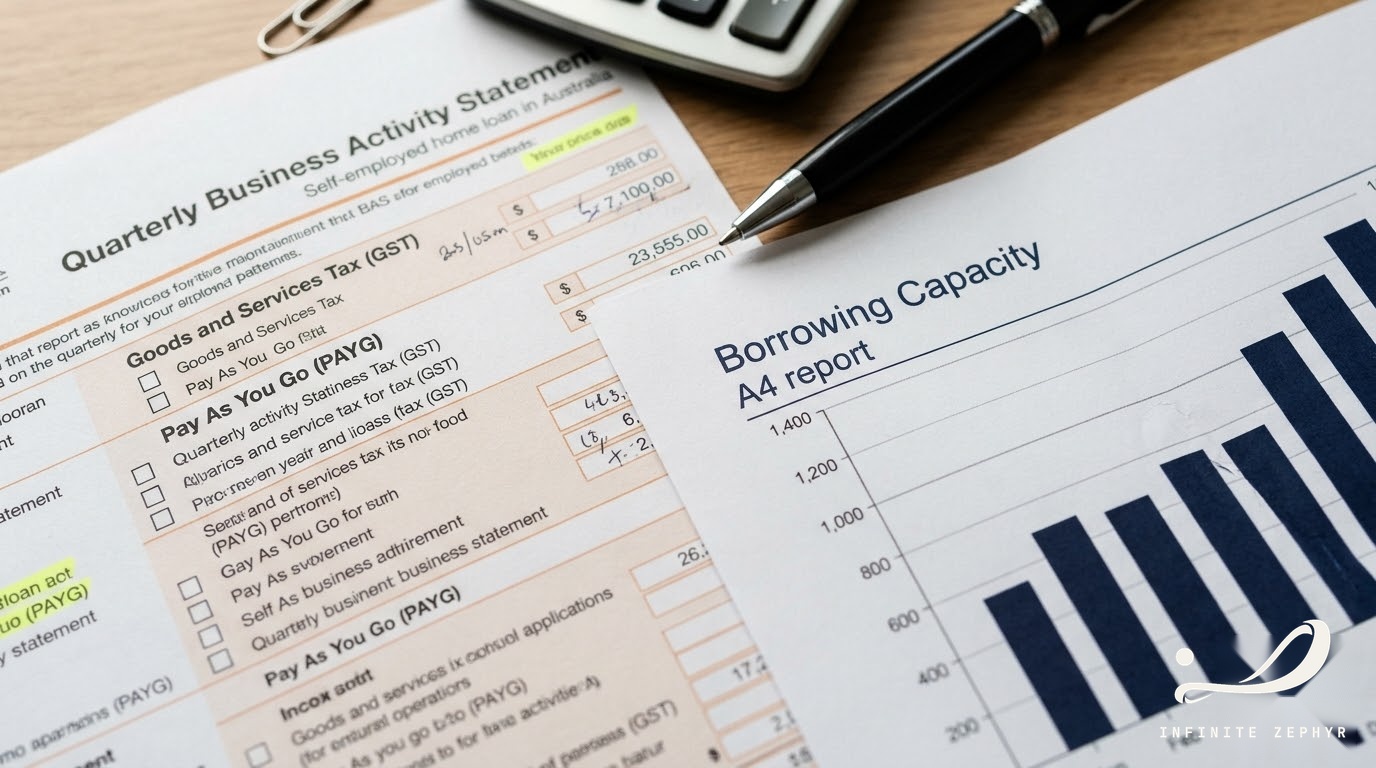
Expect to provide tax and business records that show income over time, along with the household information any borrower provides. Each lender sets its own list, so ask which records it accepts before you apply. The table explains what the common documents show.
| Document | What it shows |
|---|---|
| Lodged tax return | The income-tax information you submitted for the year |
| ATO notice of assessment | The ATO’s assessment after processing the return: tax on taxable income, credits and the amount payable or refundable |
| Business Activity Statement (BAS), if registered for GST | GST collected and credits claimed for the reporting period |
| Business and personal income and expense records | How money moves in and out of the business and the household |
| Deposit, savings and debt details | Your deposit, other savings and existing repayment commitments |
These records are not interchangeable. The notice covered in the ATO’s notice of assessment guidance is issued after the return is processed, so check that you have both documents. A business registered for GST lodges a Business Activity Statement to report GST.
The ATO’s 2026 guidance requires GST registration at GST turnover of $75,000 or more ($150,000 or more for non-profit organisations); once registered, businesses must lodge a BAS.
How to find your notice of assessment
If the ATO is linked to your myGov account, your notice of assessment goes to your myGov Inbox. Find copies of current and previous notices through myGov → ATO → My profile → Communication → History.

How Do Lenders Assess Self-Employed Income?
Lenders look at whether your income, after business costs and personal commitments, supports the proposed repayments. For a self-employed borrower, that usually means looking at:
- business receipts and business expenses;
- income tax on the business income;
- household living costs;
- existing debts and other commitments;
- how evenly money arrives through the year.
The worked example below separates these stages; it is not a lender’s borrowing-capacity calculation. Cash flow—the money moving into and out of a business, covered in Moneysmart’s self-employment guidance—matters because customer payments can arrive late, so an annual total alone may not show when money is available.
Moneysmart’s 2026 guidance defines loan-to-value ratio (LVR) as borrowing compared with property value: a $450,000 loan for a $600,000 home is 75% LVR. Moneysmart’s 2026 guidance says a lower LVR means lower costs and better approval chances; above 80%, lenders mortgage insurance (LMI) may be payable at settlement or added to the loan. A smaller deposit can therefore increase costs; lender policies vary.
Illustrative example (hypothetical, not a real client):A sole trader compares business receipts with household commitments. All amounts below are hypothetical, not typical earnings, tax calculations or lender assessment figures. The final figure is not an available mortgage repayment amount.
Stage Hypothetical annual amount or calculation Business receipts: turnover $120,000 Business expenses $40,000 Receipts less expenses, before income tax $120,000 − $40,000 = $80,000 Personal living costs $48,000 Existing debt commitments $12,000 Personal costs plus debt commitments $48,000 + $12,000 = $60,000 Remaining before income tax and further reserves $80,000 − $60,000 = $20,000 This example does not calculate borrowing power, tax payable or approval prospects and is neither a projection nor personal advice.
Not sure how this applies to you?
Start with a free Financial Health Check™ — a simple way to see where you stand before any advice is given.
Common mistakes when presenting self-employed income
- Treating turnover as income. Business receipts are not what remains after business expenses, tax and personal commitments.
- Mixing business and personal money. Keep them separate; mixed records make outgoings harder to explain.
- Using a BAS as an income summary. A BAS reports GST; it does not replace the tax return and notice of assessment.
- Borrowing the maximum offered. What a lender is willing to lend can differ from what you feel comfortable repaying.
- Treating pre-approval as approval. The lender still assesses your circumstances and the property before final approval.
Strong annual receipts can sit alongside difficult cash-flow periods. Records that explain both the annual position and the quieter months give a lender a clearer picture. What a lender is willing to lend can also differ from what you feel comfortable repaying, so prepare a household budget even when the figures look strong.
What If Your Business History Is Short or Records Are Missing?
A short business history and missing records are different problems, and each has its own next step.
- Short business history: ask the lender, or a broker, which evidence it will assess for a business with fewer years of records. Ask before you apply, so you know what is missing and what each option costs.
- Missing records: retrieve them first. Notices of assessment for current and previous years are available through myGov (see How to find your notice of assessment above). A lodged tax return or BAS that cannot be found is a records question to sort out before the application, not during it.
Moneysmart’s glossary defines a low-doc loan as requiring less financial documentation to prove income, assets and liabilities than a standard loan. Typically used by self-employed people and small business owners, these loans usually carry higher interest rates and may have restrictive terms. Evidence requirements and terms vary by lender.
How Can a Self-Employed Person Prepare to Get a Home Loan?
Preparation has two parts: assemble the evidence (tax returns and notices of assessment, BAS if registered for GST, separate business and personal summaries) and check your household budget. Keep the 3 to 6 month pre-approval window in mind as you work through them.
A practical preparation checklist
- [ ] Locate each lodged tax return and its notice of assessment. The ATO issues the notice after processing the return; finding one does not mean you have both.
- [ ] Check your myGov Inbox if the ATO is linked. Copies of notices are also available through ATO → My profile → Communication → History.
- [ ] Gather BAS records separately if registered for GST. BAS reports GST collected and credits claimed, a different purpose from income-tax documents.
- [ ] Prepare separate business and personal income-and-expense summaries. Mixed records make it harder to tell business outgoings from household spending.
- [ ] Prepare a household budget. Record living costs, financial commitments, deposit and other savings rather than treating turnover as spending capacity.
- [ ] Note the pre-approval period. Moneysmart says pre-approval generally lasts 3 to 6 months, and the lender still assesses your circumstances and the property before final approval.
When personal advice matters
- Business owners with slow-paying customers may have uneven cash flow despite complete records.
- Applicants with substantial existing commitments may have limited room for another repayment.
- Applicants with pre-approval still face further assessment of their circumstances and the property before final approval.
When Can a Mortgage Broker Help?
A mortgage broker can explain the borrowing process, compare loan options and organise the application around your records. The intermediary role covered in Moneysmart’s guide to using a mortgage broker involves exploring your needs, explaining loan options and costs, and supporting the application through to settlement. A broker does not replace the lender’s own assessment.
Moneysmart says brokers must act in your best interests when suggesting a loan. Check that the broker holds a credit licence or represents a credit licensee, which records are still outstanding, what each option costs and which lenders the broker can and cannot access. Our overview of how a mortgage broker works covers these checks in more detail.
How We Work at Infinite Zephyr
At Infinite Zephyr, we provide financial advice and mortgage broking within one practice, under separate authorisations. Our mortgage broker is a Credit Representative (CRN 513835) of Outsource Financial Pty Ltd (ACL 384324).
Our services include mortgage and lending, and we work alongside a client’s accountant and solicitor. Advice fees are agreed in writing before work begins; our pricing page explains how we price advice.
A practical next step is to assemble your tax records and household budget side by side.
Tax laws are complex and subject to change. This information is a general summary only and should not be relied upon as formal tax advice.
Frequently Asked Questions
These answers cover practical questions about records, deposits and pre-approval.
What does a notice of assessment record?
Your ATO notice of assessment records the tax assessment after your return is processed, including tax on taxable income, credits and the amount payable or refundable. It is a tax assessment, not a lender’s assessment of your repayment capacity.
Can I still apply if I cannot find an old notice of assessment?
A missing copy does not mean the record is lost. Find current and previous notices through myGov-linked ATO services, using the steps in How to find your notice of assessment above.
Is every dollar in my business account available for a deposit?
No. Your account balance alone does not show what remains after business expenses and other commitments. Business cash flow includes money coming in and going out, so read the balance alongside those outgoings.
Is the amount a lender offers necessarily comfortable to borrow?
No. What a lender is willing to lend you can differ from what you feel comfortable repaying. A household budget makes that difference visible.
Does pre-approval mean I have to take the loan?
No. Pre-approval does not oblige you to accept the loan, and the application remains subject to further assessment before final approval.
Next step
Self-employed and wondering if you can borrow?
We can help you work out what documents to prepare and what a lender will need to verify.
Start with a free Financial Health Check™
General information only. Personal advice requires an agreed scope and may need a Statement of Advice (SOA) or Record of Advice (ROA). Fees are agreed in writing before you start.
Sources: Moneysmart, Buying a house, Self-employment and Using a mortgage broker; Australian Taxation Office, Your notice of assessment. Checked November 2026. Moneysmart, Low-doc loan and Save for a house deposit; ATO, Registering for GST.
General information only. This article is general in nature and is not personal financial, credit, legal or tax advice. It doesn’t take into account your objectives, financial situation or needs, so consider whether it suits you and get advice from a licensed adviser and a registered tax agent before acting. Rules on tax, super and lending change. This article reflects legislation and ATO/ASIC guidance current as of 2026 and isn’t updated retrospectively, so confirm current rules with a registered tax agent or the ATO. Past performance is not a reliable indicator of future performance.
Infinite Zephyr is an Authorised Representative (AR 001268024) of NDT Capital Pty Ltd (AFSL 558899). Dean Nguyen is a Credit Representative (CRN 513835) of Outsource Financial Pty Ltd (ACL 384324). Verify us on the ASIC Financial Advisers Register. For complaints, contact AFCA.