By Minh Le, CFA
I spent most of my career working in Australia, dealing with sophisticated systematic strategies across developed markets, so I knew very little about Vietnam’s equity market. It was only in mid-2023 that I had the opportunity to take up a Portfolio Manager position at UOB Asset Management in Vietnam, and since then this market has captured all my attention. It is what we often see in frontier and emerging equity markets: highly dynamic, chaotic and risky, but also full of fascinating opportunities.
On 21 September 2026, FTSE Russell’s reclassification of Vietnam from Frontier to Secondary Emerging market status began to take effect, ending eight years on the watch list. This marks a milestone for the market, which has finally moved beyond its “primitive” stage and met certain international standards. FTSE Russell estimates about US$6bn of passive inflows; the World Bank sees about US$5bn in the near term and up to US$25bn by 2030 as active emerging-market money follows. For a market that foreigners sold at a record pace in 2025, this is a real change in the investor base.
Let’s have a quick look at the Vietnam stock market.
Vietnam Stock Market Structure
Vietnam’s equity market is young (the Ho Chi Minh City exchange opened in 2000) and runs on three venues:
- HOSE (Ho Chi Minh City): the main board, with about 400 listings and almost all large caps. Benchmarks are the VN-Index and the VN30 (30 largest, most liquid names).
- HNX (Hanoi): smaller companies and the government bond market.
- UPCoM: a registration venue for about 850 unlisted public companies, many of them part-privatised state-owned enterprises.
Total market capitalisation across the three venues is more than US$300bn, somewhere in the range of 60 – 80% of GDP — small for an economy of 100 million people growing at 7–8%. Four structural features stand out:
- Retail dominates. Domestic individuals account for about 85–90% of trading value, producing high turnover, momentum-driven moves and sharp swings when margin lending is cut back.
- Foreign ownership limits (FOL). Foreign holdings are generally capped at 49% (30% for banks). Quality names such as FPT, MWG and PNJ have sat at their caps for years, so foreigners trade among themselves, often at a premium.
- The state is still a large owner. Vietcombank, BIDV, PV Gas and Vinamilk (via SCIC) carry large state stakes, reducing free float and slowing corporate decisions.
- Market plumbing is improving. The non-prefunding rule (Nov 2024) lets institutions trade without depositing cash upfront, and the KRX trading system (May 2025) enables intraday trading, faster settlement and, later, short selling and central counterparty clearing.
Sector Allocation
The VN-Index is highly concentrated. Approximate weights by market capitalisation:
| Sector | Approx. weight | Key names |
|---|---|---|
| Financials (banks, brokers, insurers) | ~35–40% | VCB, BID, CTG, TCB, MBB, VPB, SSI |
| Real estate | ~15–20% | VIC, VHM, VRE, KDH, NVL |
| Materials | ~7% | HPG (steel), DGC (chemicals) |
| Consumer staples | ~6–7% | VNM, MSN, SAB |
| Industrials | ~5–6% | GMD, VJC, ACV |
| Energy & utilities | ~5–6% | GAS, POW, PLX |
| Consumer discretionary | ~4% | MWG, PNJ, FRT |
| Information technology | ~3% | FPT |
The index is really a bet on credit growth and property: banks and real estate together are more than half of it, and the Vingroup complex alone drove a large share of the 2025 gain (by the time of writing this article, they probably account for a near 30% of the main equity index).
Vietnam is often described in the media as the next Asian tiger, a country whose “golden” population structure, growing middle class, fast technology adoption and rapid urbanization together promise a bright future among its Southeast Asian peers. Interestingly, the sectors that best capture Vietnam’s structural story — consumer, technology and FDI-linked manufacturing — are thinly represented on the stock market, so stock selection matters more here than in most markets.
Not sure how this applies to you?
Start with a free Financial Health Check™ — a simple way to see where you stand before any advice is given.
Liquidity
Liquidity has improved sharply over the years. Market-wide turnover rose about 33% in 2025 to a record; HOSE averaged roughly VND 20–25trn (US$0.8–1bn) a day, with peak sessions near VND 50trn (US$1.9bn) — among the most traded markets in ASEAN. The caveats: turnover is concentrated in the VN30 and a few mid-caps, it depends on retail sentiment and margin lending, and it can halve within weeks when the mood turns (as in 2022).
Beyond the top 60–80 names, large institutions struggle to build meaningful positions. Major fund managers tend to hold the same companies in their portfolios, hence similar exposure to certain risk factors.
Performance Over the Past Decade
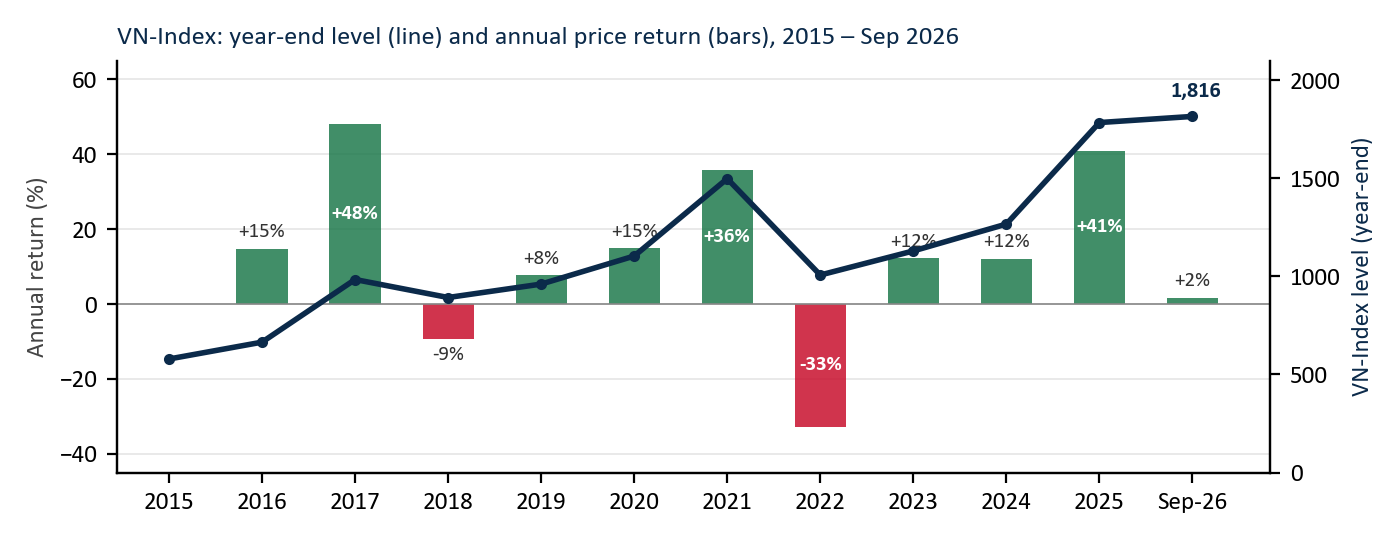
Chart 1 · VN-Index: year-end level (line) and annual price return (bars), 2015 – Sep 2026.
From about 579 at end-2015 to about 1,816 today, the VN-Index has roughly tripled — a compound gain of about 11% a year in VND before dividends. After roughly 1.5% a year of VND depreciation, US-dollar returns are closer to 9–10%, with dividends adding another 1.5–2%. That beats MSCI Emerging Markets and most ASEAN peers over the period. The path was volatile, however: two drawdowns of 30% or more (the 2020 COVID sell-off and the 2022 corporate-bond crisis following the Tan Hoang Minh and Van Thinh Phat fraud cases, tighter margin lending and higher rates), and returns came in bursts — 2017, 2021 and 2025 delivered most of the decade’s gain.
Since 2025, the market has seen significant divergence in performance among its large-cap companies. Vingroup (VIC) rose more than 700% and accounted for most of the index’s 41% gain for the year, while other quality companies suffered heavily in terms of price returns. Most traditional stock-picking managers underperformed by roughly 20–25 percentage points, and some had their accumulated alpha wiped out in a single year. The situation has continued into 2026, signaling a major structural change and perhaps suggesting that fundamental analysis has become obsolete. Investors are now looking at more efficient products such as ETFs and other index-tracking funds.
Bottom line: to invest in Vietnam’s equity is to buy a volatile, bank-heavy, retail-driven market whose index poorly represents the underlying economy. For long-horizon investors, Vietnam is one of the more compelling structural growth stories among frontier and emerging markets. It is best accessed through active, bottom-up selection in consumer, technology, quality banks and industrials rather than the index, with position sizes that can tolerate a 30% drawdown every few years.
Is this risk worth taking with your capital?
Frequently Asked Questions
What is the main index of the Vietnam stock market?
The VN-Index, which covers the main board of the Ho Chi Minh City exchange (HOSE). The VN30 tracks the 30 largest and most liquid names on that board.
How big is the Vietnam stock market?
Total market capitalisation across HOSE, HNX and UPCoM is more than US$300bn, somewhere in the range of 60–80% of GDP. HOSE has about 400 listings, and UPCoM is a registration venue for about 850 unlisted public companies.
Can foreign investors buy shares in the Vietnam stock market?
Yes, within foreign ownership limits. Foreign holdings are generally capped at 49% of a company, or 30% for banks. Some sought-after companies have been at their caps for years, so foreigners trade those shares among themselves, often at a premium.
What does the FTSE Russell upgrade mean for Vietnam?
From 21 September 2026, FTSE Russell’s reclassification of Vietnam from Frontier to Secondary Emerging market status began to take effect, ending eight years on the watch list. FTSE Russell estimates about US$6bn of passive inflows; the World Bank sees about US$5bn in the near term and up to US$25bn by 2030.
How volatile is the Vietnam stock market?
Over the past decade the VN-Index had two drawdowns of 30% or more: the 2020 COVID sell-off and the 2022 corporate-bond crisis. Turnover depends on retail sentiment and margin lending, and it can halve within weeks when the mood turns.
Why doesn’t the VN-Index reflect Vietnam’s economy?
Banks and real estate together make up more than half of the index, while the sectors that best capture Vietnam’s structural story (consumer, technology and FDI-linked manufacturing) are thinly represented on the stock market.
Next step
Weighing up emerging-market exposure?
We can talk through how a higher-risk allocation would sit within your wider plan.
Start with a free Financial Health Check™
General information only. Personal advice requires an agreed scope and may need a Statement of Advice (SOA) or Record of Advice (ROA). Fees are agreed in writing before you start.
Sources: HOSE; FTSE Russell; World Bank; DTiNews, VietnamPlus, Viet Nam News, Vietnam Briefing, The Investor (2025–26). Index levels and flows are sourced; sector weights, market capitalisation and valuation multiples are approximate and should be verified against current HOSE / Bloomberg / FiinPro data. For information only; not investment advice.
General Advice Warning: This information is general in nature only and does not constitute personal financial, legal, or tax advice. It has been prepared without taking into account your objectives, financial situation, or needs. Before acting on any information, consider whether it suits you and seek advice from a licensed financial adviser and registered tax agent. Past performance is not a reliable indicator of future performance.
This article is published jointly by Infinite Zephyr and Vietinvest.au, both under NDT Capital Pty Ltd (AFSL 558899). Infinite Zephyr is an Authorised Representative (AR 001268024) and Vietinvest.au is a Corporate Authorised Representative (CAR 001311348) of NDT Capital. You can verify these authorisations on the ASIC Financial Advisers Register. For dispute resolution, contact the Australian Financial Complaints Authority (AFCA).