Superannuation tax rates depend on whether money enters your fund, earns investment income or is withdrawn; there is no single rate for every stage. Contribution type, fund phase and payment category determine which treatment applies.
This reference separates rates from caps and exceptions for Australian business owners and high-income professionals; our parent guide explains the broader superannuation tax framework.
Key takeaways
- The ATO distinguishes concessional contributions, which attract contributions tax, from after-tax non-concessional contributions.
- The ATO sets annual caps for both concessional and non-concessional contributions, subject to individual eligibility.
- Investment earnings tax inside a fund and tax on a withdrawal are separate calculations.
- Division 293 uses a specified income calculation plus relevant concessional contributions, rather than salary alone.
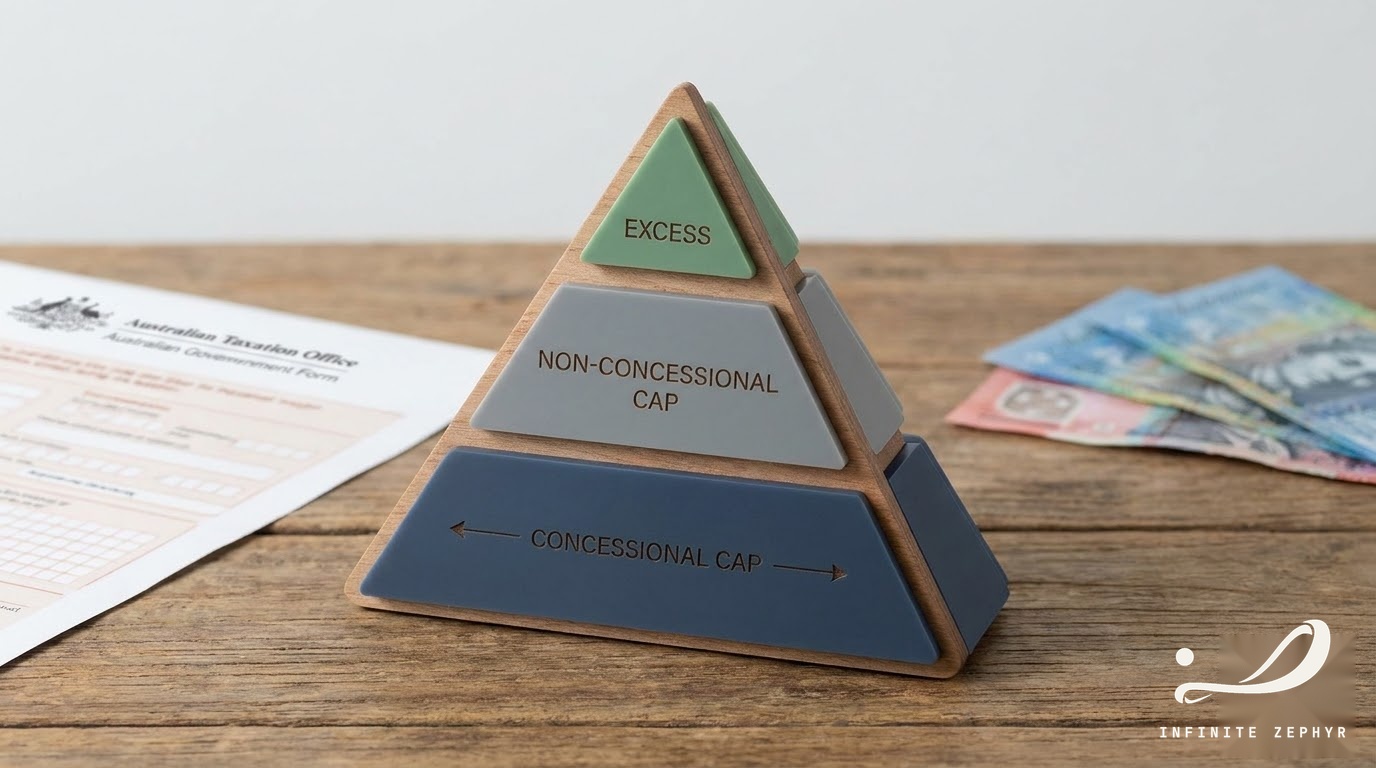
Which Superannuation Tax Rates Apply?
The ATO generally taxes concessional contributions and accumulation-phase investment earnings at 15%. Non-concessional contributions generally attract no additional contributions tax within the applicable cap. Retirement-phase earnings and withdrawals follow different rules.
Money contributed → investment earnings → benefit paid
| Category | General treatment | Main qualification |
|---|---|---|
| Concessional contributions | 15% deducted by the fund | Division 293 and excess contributions can alter treatment |
| Non-concessional contributions | No additional contributions tax within the applicable cap | Eligibility and cap exceptions apply |
| Accumulation investment earnings | 15% | Distinct from contributions and withdrawal tax |
| Retirement-phase investment earnings | Exempt | Subject to the transfer balance cap |
| Taxed element of an ordinary lump sum received from age 60 | No tax | Assumes a condition of release is met; excludes untaxed elements |
The general 15% contributions rate does not resolve Division 293 or excess-contribution tax. Tax laws are complex and subject to change. This information is a general summary only and should not be relied upon as formal tax advice.
How Do Contributions and Caps Affect the Calculation?
Concessional and non-concessional contributions are subject to annual caps, although eligibility and existing arrangements can change the amount available.
Concessional contributions include employer contributions, salary sacrifice and personal contributions for which a deduction is allowed and claimed. Personal contributions without a deduction are non-concessional. Contributions across all your funds count towards the relevant cap.
If you exceed your cap, you will have to pay extra tax. Excess concessional amounts left in super also count towards the non-concessional cap. The general annual cap therefore cannot resolve every contribution position.
Read more: Superannuation Tax Deduction: How to Claim
How Do Superannuation Tax Rates Differ for Earnings and Withdrawals?
The ATO distinguishes income earned inside super from benefits paid to a member. Accumulation is the stage in which money builds within the fund; retirement-phase earnings may be exempt, subject to the transfer balance cap. Neither treatment, by itself, determines the tax on a payment you receive.
For withdrawals, a condition of release is a requirement permitting access to super. Meeting that requirement and determining the tax treatment are separate steps.
A benefit can contain a tax-free component and a taxable component. Within the taxable component, a taxed element has already been taxed in the fund; an untaxed element has not.
Under ATO guidance on tax on super benefits, ordinary taxed-element lump sums received from age 60 are not taxed. Untaxed elements and capped defined benefit income streams require different treatment. “Tax-free after 60” is therefore too broad as a universal statement.
Investment capital gains tax calculations and additional large-balance measures require separate treatment; the headline earnings row is not a reference for every investment-tax question.
When Does Division 293 Affect Contributions?
The ATO’s Division 293 rules, apply when specified income plus relevant concessional contributions exceeds $250,000. Division 293 can result in additional tax on concessional contributions.
Salary alone does not settle the calculation. Division 293 tax is based on combined income and concessional super contributions for Division 293 purposes.
A concessional contribution can remain within an available cap while also entering this separate calculation.
A capital gain, termination payment or back pay can cause Division 293 to apply in a year when it would not ordinarily affect the person. Business owners should distinguish recurring income from amounts arising from a particular transaction or payment.

Why Is an Assessable Proportion Not a Tax Rate?
The ATO’s capped defined benefit rules distinguish the portion included in assessable income from the tax charged on that income. Assessable income is income included in the person’s tax calculation. The historical example below uses the cap for its stated financial year, not a current-year cap.
Illustrative example (hypothetical, not a real client):
Following the figures in the ATO’s 2020–21 example, a person aged 62 receives a capped defined benefit income stream of $117,000. It comprises a $67,000 tax-free component and a $50,000 taxable component, entirely consisting of a taxed element. The defined benefit income cap for the example is $100,000.
Amount above the cap: $117,000 − $100,000 = $17,000.
Amount included in assessable income: $17,000 × 50% = $8,500.
The $8,500 enters assessable income and is taxed at the person’s marginal rates.
The 50% is an assessable proportion, not a tax rate. This example does not calculate final tax liability and is neither a projection nor personal advice.
Not sure how this applies to you?
Start with a free Financial Health Check™ — a simple way to see where you stand before any advice is given.

What Belongs on a Rate-Checking Checklist?
The ATO’s classifications make applicability the starting point, rather than the headline percentage. The following checklist separates the questions that determine which row applies. For someone with several accounts, additional contribution entitlements or an unusual benefit, a general annual cap or withdrawal rate may not answer the whole question.
- Match the period.
- Classify personal contributions. A deduction allowed and claimed makes the contribution concessional; without a deduction, it is non-concessional.
- Combine fund records. Separate accounts do not create separate contribution caps.
- Identify the fund phase. Accumulation and retirement-phase earnings have different treatment.
- Check Division 293 separately. Use its specified income calculation and relevant contributions.
- Classify the withdrawal. Establish the condition of release, age, payment type, components and taxed or untaxed elements.
When personal advice matters
A headline-rate table may not be sufficient for the following circumstances:
- People receiving defined benefit income streams or benefits containing untaxed elements may face additional caps and exceptions.
- People with excess contributions, carry-forward amounts or bring-forward arrangements may have a contribution position that differs from the general annual cap.
- People receiving death benefits or certain invalidity benefits require separate assessment rather than the ordinary withdrawal rows.
At Infinite Zephyr, we can discuss how contribution caps, Division 293 and withdrawal components relate to a person’s superannuation circumstances.
Our financial advice services can include a review of these separate contribution and benefit questions.
Where that review involves several funds or defined benefit arrangements, the factors affecting advice costs are explained on our pricing page.
Frequently Asked Questions
Is the super guarantee rate a super tax rate?
No. ASIC’s Moneysmart explains the super guarantee as an employer contribution, while contributions tax concerns how a contribution is taxed. They describe different parts of the super system.
Does having several funds give me several contribution caps?
No. The ATO combines contributions across all funds when checking the relevant cap. Account-by-account records therefore need to be considered together.
Can I choose to withdraw only the tax-free component?
Generally, no. The ATO says a member cannot select only the tax-free component unless the entire account is tax-free. The account’s components matter when determining withdrawal treatment.
Are contribution caps limits on my total account balance?
No. Contribution caps limit contributions, rather than measuring the total balance already held in super. An account balance and an annual contribution limit measure different things.
Is Division 293 the same as excess-contributions tax?
No. Division 293 uses combined income and relevant concessional contributions, while excess-contributions rules concern amounts above the applicable cap. A contribution can remain within an available cap and still count in the Division 293 calculation.
Next step
Talk through your retirement plan
We can model how the rules in this guide apply to your situation, across super, investments and your other assets.
Start with a free Financial Health Check™
General information only. Personal advice requires an agreed scope and may need a Statement of Advice (SOA) or Record of Advice (ROA). Fees are agreed in writing before you start.
Sources: Australian Taxation Office, Personal super contributions; Division 293 tax on concessional contributions by high-income earners; Tax on super benefits. ASIC Moneysmart, Employer contributions.
Tax, superannuation, and regulatory information in this article is based on legislation and ATO/ASIC guidance current as of 2026. These rules are complex and subject to change, and this article is not updated retrospectively when they do. This information is a general summary only and should not be relied upon as formal tax advice — always confirm current rules with a registered tax agent or the ATO directly.
General Advice Warning: This information is general in nature only and does not constitute personal financial, legal, or tax advice. It has been prepared without taking into account your individual objectives, financial situation, or needs. Before acting on any information, you should consider its appropriateness having regard to your objectives, financial situation, and needs, and seek professional advice from a licensed financial adviser and registered tax agent. Past performance is not a reliable indicator of future performance.
This information is provided by Infinite Zephyr, an Authorised Representative (AR 001268024) of NDT Capital Pty Ltd (AFSL 558899). You can verify this authorisation on the ASIC Financial Advisers Register. For dispute resolution, contact the Australian Financial Complaints Authority (AFCA).