Start with the average super balance for your age group. To estimate how much you may need in retirement, factor in when you expect to retire, your housing costs and other income.
Average Super Balances by Age: Where Australians Stand
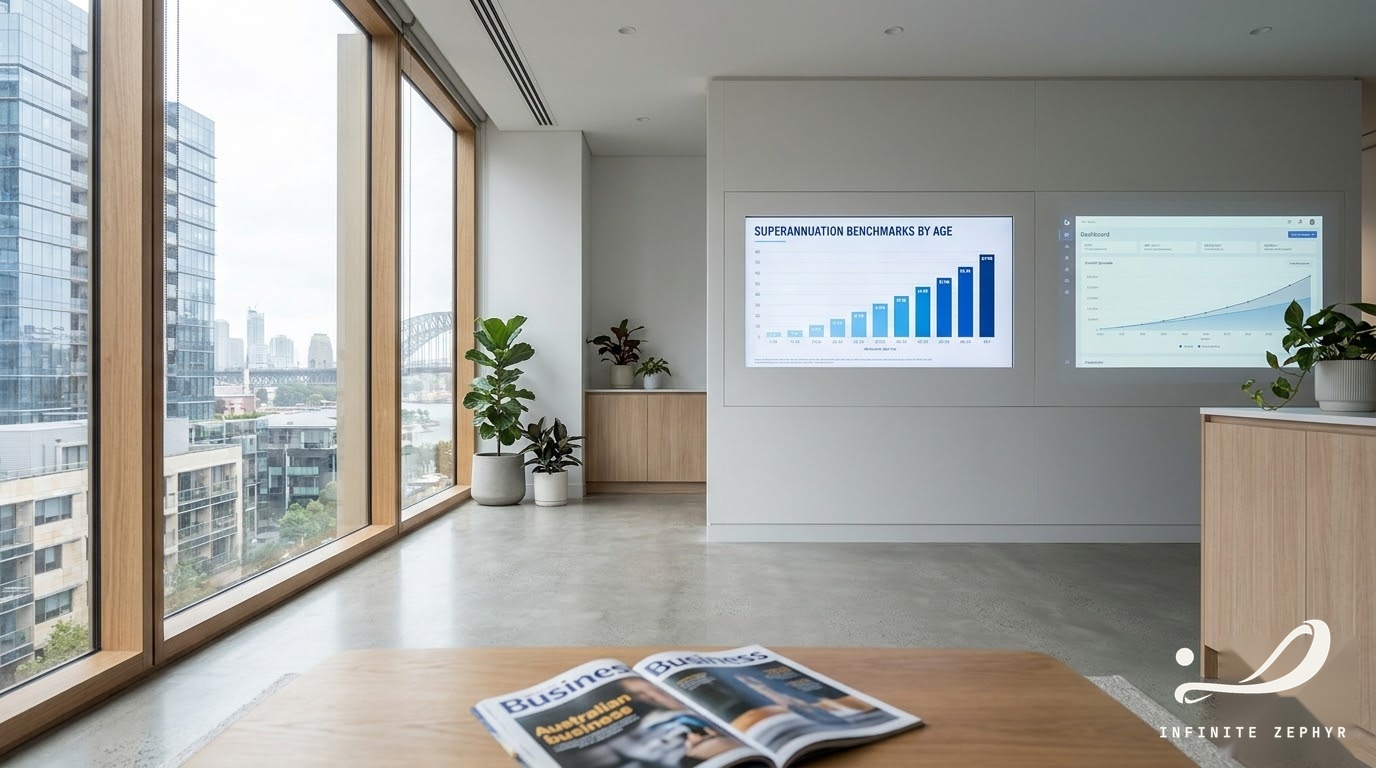
The table shows average super balances in Australia by age group, based on APRA’s June 2026 quarterly data published by Moneysmart. Figures are rounded to the nearest $100.
| Age group | Average super balance (AUD) |
|---|---|
| Under 25 | $9,400 |
| 25–29 | $28,800 |
| 30–34 | $55,200 |
| 35–39 | $88,400 |
| 40–44 | $123,400 |
| 45–49 | $157,900 |
| 50–54 | $198,000 |
| 55–59 | $243,300 |
| 60–64 | $270,800 |
| 65–69 | $290,600 |
| 70–74 | $312,000 |
| 75–84 | $302,900 |
| 85+ | $199,500 |
Income, career breaks and time in the workforce can all affect your balance. The benchmarks below can help you estimate a retirement savings target based on your circumstances. See our guide to retirement planning in Australia for a starting point.

Target Super Benchmarks: What the Data Shows for Comfortable and Modest Lifestyles
ASFA figures published by Moneysmart (checked October 2026) indicate a single retiree reaching age 67 would need around $630,000 in super for a comfortable standard of living, or $110,000 for a modest lifestyle. These figures assume the individual owns their home outright and take into account the Age Pension where applicable. For a single person renting, ASFA estimates that a balance of $340,000 at age 67 is required to support a modest retirement standard.
Super Consumers Australia offers separate savings guidelines evaluated at age 65 (checked October 2026). For a single individual who owns their home, their expenditure tiers project super balances of $74,000 for low spending, $322,000 for medium expenditure, and $891,000 for high living costs.
| Standard / Research Body | Target Balance (Single) | Target Age | Housing Assumption | Government Pension Factored In? |
|---|---|---|---|---|
| ASFA Modest | $110,000 | 67 | Owns home outright | Yes |
| ASFA Modest (Renter) | $340,000 | 67 | Renting privately | Yes |
| ASFA Comfortable | $630,000 | 67 | Owns home outright | Yes |
| Super Consumers Australia (Low) | $74,000 | 65 | Owns home outright | Yes |
| Super Consumers Australia (Medium) | $322,000 | 65 | Owns home outright | Yes |
| Super Consumers Australia (High) | $891,000 | 65 | Owns home outright | Yes |
Read more: Age Pension 2026: Rates, Income Test, Assets Test and Deeming
How Much Super Should I Have at 40? Mid-Career Milestones
APRA figures from June 2026 show that Australians aged 40 to 44 hold an average super balance of $123,400. Those aged 35 to 39 hold an average of $88,400. At age 40, individuals typically have approximately 25 to 27 years of workforce participation remaining before reaching the standard Age Pension qualification age of 67.
Target Super Balances at 50: Preparing for the Final Accumulation Phase
The APRA June 2026 statistics confirm that the average balance for individuals aged 50 to 54 is $198,000. This figure rises to $243,300 for those aged 55 to 59. Reaching age 50 marks the start of the final accumulation phase. It leaves approximately 10 to 17 years to bridge any difference between an existing balance and retirement targets.
For details on defensive buffers and multi-year cash reserves, read our overview of sequencing risk in retirement.
Illustrative example (hypothetical, not a real client): A 50-year-old single homeowner has an existing super balance of $198,000, matching the APRA June 2026 national average for the 50–54 age bracket. Reaching the ASFA comfortable benchmark of $630,000 at age 67 requires bridging a $432,000 gap ($630,000 minus $198,000) over 17 years. Assume hypothetical net earnings and compulsory contributions add an average of $26,000 to the balance each year. In this scenario, the balance grows by $442,000 (17 multiplied by $26,000), reaching an estimated $640,000 at age 67. This is a simplified illustration, not a projection: actual returns vary and can be negative, but it shows how steady contributions and earnings over many years can narrow the gap.
Not sure how this applies to you?
Start with a complimentary Financial Health Check™ — a simple way to see where you stand before any advice is given.
How Much Super Should I Have When I Retire? The Sydney Property Reality
According to ASFA figures published on Moneysmart (checked October 2026), reaching age 67 with around $630,000 in super supports a comfortable retirement for a single homeowner, taking into account the Age Pension where applicable. However, for a single person renting privately, ASFA calculates that a balance of $340,000 is needed merely to sustain a modest lifestyle at age 67.
The fundamental assumption underpinning national retirement benchmarks is debt-free home ownership.
Read more: How Much Super Do I Need to Retire in Australia?
Read more: Should You Pay Off Your Mortgage Before Retirement in Australia?
How Much Super Are You Allowed to Have? Division 296 and Contribution Rules
Starting 1 July 2026, Division 296 introduces a 15% tax on calculated superannuation earnings linked to balances exceeding $3 million, with an additional 10% rate for balances over $10 million. For detailed rules on indexation, payment deadlines, and balance calculations, review our complete breakdown of Division 296 tax on large super balances. Tax laws are complex and subject to change. This information is a general summary only and should not be relied upon as formal tax advice.
Accessing Super and Preservation Milestones
The Australian Taxation Office (ATO) establishes that individuals can access accumulated super once they reach their preservation age and retire, turn 65, or start a transition to retirement income stream while working. In addition, the ATO confirms that if an individual is aged 60 or older and their sole income is from a taxed super fund, payments are generally tax-free. Such individuals generally do not need to lodge a tax return.
Preservation age is the minimum age set by law before an individual can access superannuation benefits under an approved condition of release. To review birth years and early release criteria, see our guide on superannuation preservation age rules in Australia.
Once eligible, Australians typically access superannuation through an income stream or lump sum:
- Transition to Retirement Income Streams (TRIS): Australians who have reached preservation age can access super under transition to retirement rules while continuing to work. Learn more about pension rules and commutation limits in our guide on transition to retirement withdrawal rules.
- Account-Based Pensions: Upon meeting a full condition of release, individuals can convert accumulation super into a regular pension stream. To examine minimum withdrawal rates across age brackets and rules for child beneficiaries, see our account-based pension guide.

Planning Super for Business Owners and High Earners
Business owners and corporate executives in Sydney often follow different accumulation paths than standard PAYG employees. Instead of regular employer contributions building predictably over decades, founders frequently direct capital into operational cash flow, plant equipment, commercial premises, and staff.
To explore business sale strategies and retirement pathways for founders, read our guide to planning retirement as a business owner.
When evaluating advisory firms to structure these assets, you can review our Sydney financial planner comparison to assess different advice capabilities.
How Infinite Zephyr Approaches Super and Retirement Planning
At Infinite Zephyr, our retirement planning process begins with a Financial Health Check™. We assess your income needs, asset structures, and retirement timeline.
Our advisers provide licensed guidance across superannuation, debt, property, and cash flow through our specialised financial planning services. We support Consolidators (aged 50–59) to model target dates, Transitioners (aged 60–67) to establish income streams, and Retirees (aged 67+) to manage pension drawdowns.
We agree on all professional engagement fees in advance, as set out in our advisory pricing schedule, before any personal advice, which may need a Statement of Advice (SoA) or Record of Advice (RoA).
Next step
Not sure if your super is on track?
Start with a complimentary Financial Health Check™ to see where you stand, then we can model the gap between your balance and the retirement you want.
Start with a Financial Health Check™
General information only. Personal advice requires an agreed scope and may need a Statement of Advice or Record of Advice. Fees are confirmed after your health check.
Frequently asked questions
What is an average super balance at age 40?
According to the APRA Quarterly Superannuation Statistics (June 2026), the average super balance for Australians aged 40 to 44 is $123,400, while those aged 35 to 39 hold an average of $88,400. Whether this amount is on track depends on intended retirement age, debt levels, and expected living expenses.
What target balance should individuals aim for by age 50?
APRA June 2026 statistics show that Australians aged 50 to 54 hold an average super balance of $198,000, and those aged 55 to 59 average $243,300. Entering your fifties with a balance near this benchmark leaves a noticeable gap compared to the ASFA comfortable target of $630,000 at age 67.
What super balance is recommended for retirement?
ASFA benchmarks on Moneysmart (checked October 2026) calculate that a single homeowner retiring at age 67 needs an estimated $630,000 for a comfortable lifestyle or $110,000 for a modest lifestyle, taking into account the Age Pension where applicable. If renting, ASFA estimates a balance of $340,000 is required for a modest retirement.
How much super are you allowed to have?
There is no limit on how much super you can hold. However, under Division 296 legislation taking effect from 1 July 2026, the ATO applies an extra 15% tax on earnings corresponding to the portion of a total super balance above $3 million for the 2026–27 income year, and an additional 10% on earnings exceeding $10 million.
Is my super taxed when I withdraw it after 60?
Superannuation withdrawals taken from a taxed fund by an individual aged 60 or older are generally tax-free, whether drawn as regular pension payments or lump sums. Under ATO guidance, if an individual is 60 or older and their sole income is from a taxed super source, they are generally not required to lodge a tax return.
Sources: How much super should I have – Moneysmart.gov.au (checked October 2026), Division 296 tax on large super balances | Australian Taxation Office (checked October 2026), Account-based pensions – Moneysmart.gov.au (checked October 2026), Accessing your super to retire | Australian Taxation Office (checked October 2026), Transition to retirement income streams (TRIS) | Australian Taxation Office (checked October 2026)
Tax, superannuation, and regulatory information in this article is based on legislation and ATO/ASIC guidance current as of 2026. These rules are complex and subject to change, and this article is not updated retrospectively when they do. This information is a general summary only and should not be relied upon as formal tax advice — always confirm current rules with a registered tax agent or the ATO directly.
General Advice Warning: This information is general in nature only and does not constitute personal financial, legal, or tax advice. It has been prepared without taking into account your individual objectives, financial situation, or needs. Before acting on any information, you should consider its appropriateness having regard to your objectives, financial situation, and needs, and seek professional advice from a licensed financial adviser and registered tax agent. Past performance is not a reliable indicator of future performance.
This information is provided by Infinite Zephyr, an Authorised Representative (AR 001268024) of NDT Capital Pty Ltd (AFSL 558899). You can verify this authorisation on the ASIC Financial Advisers Register. For dispute resolution, contact the Australian Financial Complaints Authority (AFCA).