Retirement planning for business owners is the structured process of separating accumulated commercial equity from personal wealth to establish reliable, long-term post-work income. Many company founders, medical practice partners, and family enterprise owners in Australia reinvest operational profits into daily trade rather than maintaining regular personal superannuation contributions. When an operational transition or company sale approaches, turning an illiquid commercial enterprise into regular personal cash flow requires advance structural planning across tax rules, superannuation limits, and corporate structures.
This guide outlines practical pathways Australian business owners use when preparing for retirement. It examines the separation of private wealth from trading liabilities, the role of self-managed super funds, and the management of shareholder loan accounts. It also reviews small business capital gains tax concessions, balance threshold rules, pension phase income streams, and succession timelines.

The Valuation Disconnect in Retirement Planning for Business Owners
Moneysmart data highlights that retirement targets vary based on desired lifestyle standards and post-work expenses. Detailed comparisons across ASFA standards, Super Consumers Australia targets, and APRA age-based averages are outlined in our guide on benchmarks for superannuation balances.
A private trading business is an illiquid commercial asset exposed to operational hazards, market shifts, customer loss, and economic cycles. Operating on the assumption that selling a trading entity will fully fund post-work years introduces vulnerability into an exit plan. If commercial revenues contract, key client contracts lapse, or unexpected health events force an early departure, a founder may face a shortfall between net sale proceeds and the capital required to sustain living costs.
| Asset Characteristic | Private Trading Business | Regulated Superannuation / SMSF |
|---|---|---|
| Liquidity | Low; conversion to cash depends on finding a buyer and completing due diligence. | Investments inside super can be bought and sold, but benefits stay preserved until a condition of release is met. |
| Asset Diversification | Concentrated; value depends on specific industry conditions, staff, and key clients. | Diversified; holdings can be spread across domestic shares, global assets, cash, and property. |
| Tax on Earnings | Company tax rates apply to taxable trading profits. | Concessional accumulation rate of 15%, moving to 0% in retirement pension phase. |
Building Private Wealth: Retirement Planning for Business Owners Using SMSFs
The Australian Taxation Office (ATO) regulates self-managed super funds (SMSFs), which allow eligible business proprietors to hold commercial real estate and direct investments under concessional superannuation tax rates. Operating an SMSF enables business principals to hold qualifying business real property directly within super, keeping those assets in a separate, regulated retirement structure.
Separating family capital from operating company risks is an important focus within business owner financial planning. Reinvesting commercial earnings solely into operating companies concentrates exposure. Regular super contributions redirect capital into an environment where investment earnings are taxed at 15% in accumulation.
Lease payments made by the trading business are generally deductible business expenses that flow into the SMSF. The underlying commercial property remains held by the fund, separating it from operating trading liabilities. An SMSF is not automatically superior to an APRA-regulated fund; trustees carry strict legal duties under superannuation legislation, requiring significant time, management discipline, and ongoing compliance costs.

Structuring an Exit Runway: Valuations, Operations, and Governance
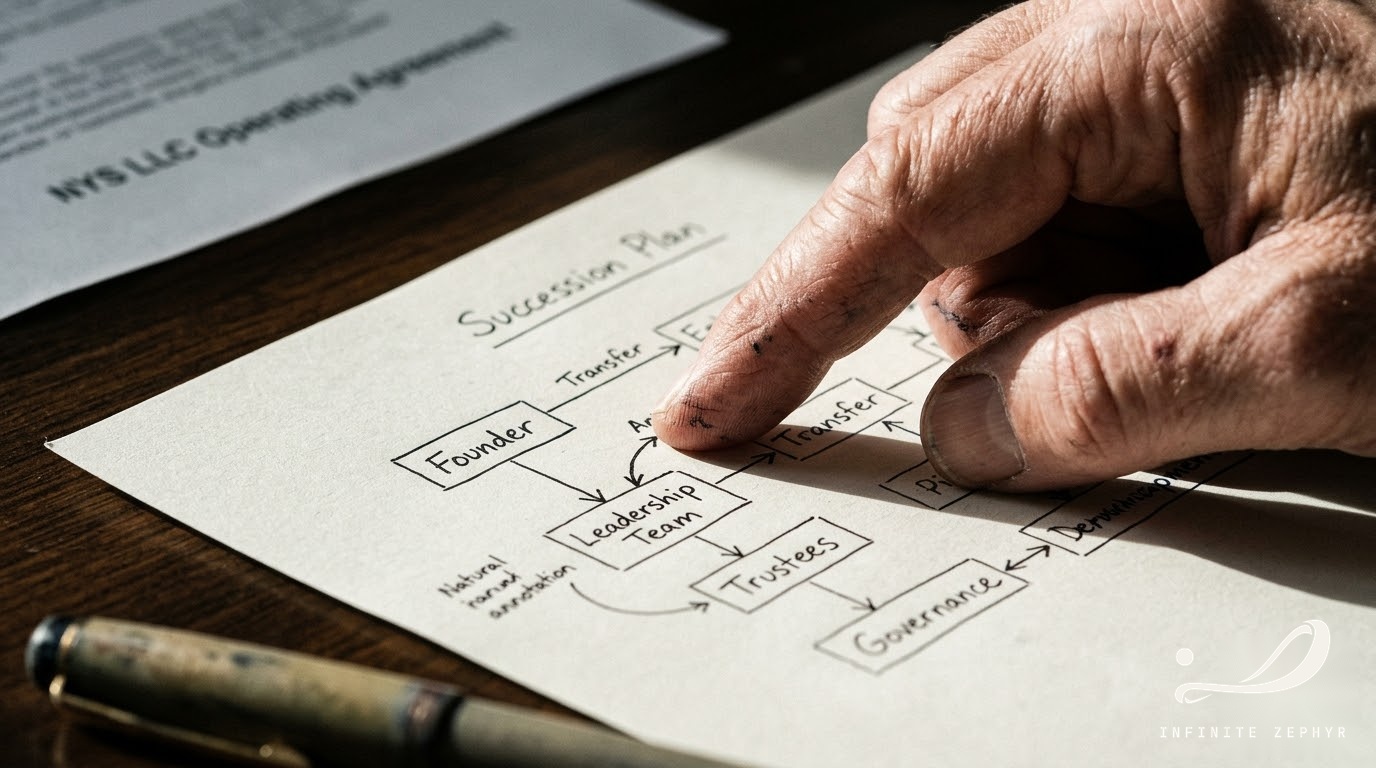
Building an exit runway usually means reducing the business’s dependence on the owner over several years. Establishing autonomous leadership, standardising operational procedures, and verifying clean financial statements protect private asset values before business assets are transferred or sold to outside parties.
When leaders begin preparing the business for exit, reducing personal operational reliance is an early milestone. Prospective purchasers evaluate an enterprise based on sustainable future earnings. If operational workflows, client relationships, and supplier contracts depend on the proprietor’s presence, buyers discount the acquisition multiple. Normalising commercial records several years prior removes discretionary owner expenditures, non-commercial family salaries, and one-off write-offs to reflect underlying profitability.
Resolving Division 7A Loans and Balance Sheet Entanglements
The Australian Taxation Office (ATO) monitors private company loans under Division 7A of the Income Tax Assessment Act, treating unmanaged shareholder withdrawals as unfranked dividends taxed at marginal rates. Business owners preparing for retirement must address outstanding debit loan balances through formal loan agreements, commercial interest repayments, or dividends to prevent unexpected tax liabilities upon exit.
Over decades of trading, owners often draw capital for personal use without formal dividend declarations. If a private company is sold with unaddressed debit loans, the ATO may treat those amounts as unfranked deemed dividends.
Resolving Division 7A balances requires multi-year planning. Common methods a licensed adviser reviews include:
- Establishing formal complying loan agreements requiring annual principal and interest repayments.
- Declaring dividends from retained company earnings over several financial years to pay down the loan.
- Transferring personal or investment assets of equivalent market value to clear company debt.
Applying Small Business Capital Gains Tax Relief in Retirement Planning for Business Owners
The Australian Taxation Office (ATO) administers small business capital gains tax concessions under Division 152, which provide specific tax relief on eligible active asset disposals for qualifying entities. Eligible business owners may explore statutory concessions—including the 15-year exemption and retirement exemption—to direct active asset proceeds into superannuation funds under dedicated legislative contribution caps.
Tax laws are complex and subject to change. This information is a general summary only and should not be relied upon as formal tax advice.
Basic eligibility requires satisfying statutory turnover or net asset value tests, alongside meeting the active asset test.
1. The 15-Year Exemption
Under statutory small business capital gains tax rules, long-held active assets disposed of in connection with retirement may qualify to have capital gains disregarded.
2. The Active Asset Reduction
Qualifying taxpayers can reduce assessable capital gains on eligible active business assets.
3. The Small Business Retirement Exemption
Provides relief on capital gains from active business assets, subject to statutory lifetime limits and superannuation contribution rules.
4. Small Business Rollover Relief
Defers assessable capital gains where replacement assets or capital improvements are acquired within statutory timeframes.
| Concession Type | Core Statutory Condition | Superannuation Interaction | Practical Exit Application |
|---|---|---|---|
| 15-Year Exemption | Long-held active business asset disposed of in connection with retirement. | Capital gain disregarded; proceeds may enter superannuation under dedicated contribution caps. | Capital gains relief on qualifying long-held family practices and businesses. |
| Active Asset Reduction | Meets basic eligibility; asset qualifies as active business property. | Reduces assessable gain; does not directly trigger superannuation contribution rights. | Reduces taxable capital gains on qualifying active business assets. |
| Retirement Exemption | Meets basic eligibility; subject to statutory lifetime limits. | Capital proceeds can enter complying superannuation structures. | Directs eligible business sale proceeds into personal retirement funds. |
| Small Business Rollover | Acquisition or improvement of qualifying active business assets. | Gain deferred; no immediate superannuation contribution trigger. | Defers capital gains liabilities while acquiring replacement operating assets. |
Managing Wealth Thresholds and Post-Exit Investment Vehicles
Individuals holding high superannuation balances may face additional tax obligations under Division 296 legislation. A detailed breakdown of these rules and asset calculations is outlined in our guide to division 296 tax explained.
Understanding how broad asset holding patterns interact with national retirement rules is covered in our resource on retirement planning in Australia. When a transaction generates capital exceeding superannuation contribution limits or transfer balance caps, establishing complementary investment vehicles becomes relevant. Holding assets across a combination of superannuation, discretionary family trusts, and corporate investment entities is an area a licensed adviser reviews.
Converting Business Exit Proceeds into Sustainable Retirement Income
Superannuation savings can be converted into regular income once a condition of release is met. Superannuation funds do not usually tax investment earnings on account-based pension accounts, allowing business owners aged 60 and over to draw income payments under generally tax-free terms.
Details on age thresholds and release conditions are set out in our guide on superannuation preservation age in Australia. Business owners wishing to scale back hours while retaining commercial interests can review our guide to transition to retirement withdrawal rules. Minimum annual withdrawal percentages and beneficiary nominations are detailed in our account-based pension guide. Holding liquid cash buffers to prevent selling down assets in market downturns is examined in our guide to sequencing risk in retirement.
Pension taxation rules apply as follows:
- Under age 60: Superannuation benefits may be subject to tax depending on individual circumstances and component structures.
- Age 60 and over: Superannuation pension payments from taxed sources are generally tax-free.
Illustrative example (hypothetical, not a real client): A 61-year-old business owner retires following the sale of an active enterprise, receiving $800,000 in net business sale proceeds. Having reached preservation age and satisfied a condition of release, the owner contributes the eligible part of the proceeds to super within the applicable contribution caps (for example under the small business capital gains tax concessions) and starts an account-based pension with it. In the pension phase, the fund incurs 0% tax on investment earnings, and regular pension withdrawals are tax-free because the owner is over age 60. This illustrates how eligible sale proceeds, once inside super within the caps, can support regular, tax-effective income; how much can go in depends on the caps and concessions that apply.
Not sure how this applies to you?
Start with a complimentary Financial Health Check™ — a simple way to see where you stand before any advice is given.
How Infinite Zephyr approaches this
At Infinite Zephyr, we assist business owners and medical practice partners through a structured advice journey matched to their life stage, whether they are Consolidators aged 50 to 59 establishing a definitive retirement date, Transitioners aged 60 to 67 shifting from building wealth to generating income, or clients aged 67 and over managing retirement drawdowns. Our process begins with a complimentary Financial Health Check™. We provide goals-based advice and financial modelling across business structuring, SMSF strategies, superannuation, and investments, with fixed fees agreed upon up front. Where personal advice is required, our recommendations are set out in a Statement of Advice (SoA) or Record of Advice (RoA).
Learn more about our specialised financial advice services or explore how our advisory fees work before taking the next step.
Next step
Planning to step back from your business?
We can map how a sale or succession, your super and your personal income fit together before you set an exit date.
Start with a Financial Health Check™
General information only. Personal advice requires an agreed scope and may need a Statement of Advice or Record of Advice. Fees are confirmed after your health check.
Frequently asked questions
How does retirement for business owners differ from employee retirement?
Retirement for business owners involves extracting wealth from an illiquid commercial entity, addressing business liabilities, and managing capital gains tax events rather than relying solely on accumulated employer superannuation contributions. While employees generally draw down on superannuation and personal savings, owners must also manage the valuation, succession, or sale of an operating enterprise. Structural coordination across shareholder loan accounts and tax concessions is also required well before stepping away from daily operations.
What are the best retirement plans for business owners in Australia?
There is no single best retirement plan, as the appropriate strategy depends entirely on a business owner’s personal goals, entity structure, and balance sheet. Matters a licensed adviser may review include whether an SMSF holding business premises suits the owner and whether small business capital gains tax concessions are available.
Which retirement accounts for business owners provide tax concessions?
Complying superannuation funds, including APRA-regulated funds and SMSFs, provide concessional tax environments for business owners. In accumulation, fund earnings are generally taxed at 15%, while balances moved into an account-based pension incur 0% tax on investment earnings, subject to the transfer balance cap.
When should retirement for small business owners be planned?
Retirement planning for small business owners often begins several years before the targeted exit date. This runway provides sufficient time to remove owner dependencies, resolve Division 7A shareholder loans, and satisfy conditions for statutory small business capital gains tax concessions.
Can business sale proceeds be contributed directly into superannuation?
Yes, eligible proceeds from active business asset sales can enter superannuation using small business capital gains tax concessions, such as the 15-year exemption or the retirement exemption. These contributions use dedicated legislative contribution caps rather than standard non-concessional contribution limits.
How does Division 296 tax affect business owners with large super balances?
Business owners who transfer substantial transaction proceeds into superannuation may be affected by Division 296 tax once balances exceed legislative limits. A licensed adviser reviews these thresholds when evaluating post-sale asset holding structures.
Sources:
- ATO: Division 296 tax on large super balances (checked October 2026)
Tax, superannuation, and regulatory information in this article is based on legislation and ATO/ASIC guidance current as of 2026. These rules are complex and subject to change, and this article is not updated retrospectively when they do. This information is a general summary only and should not be relied upon as formal tax advice — always confirm current rules with a registered tax agent or the ATO directly.
General Advice Warning: This information is general in nature only and does not constitute personal financial, legal, or tax advice. It has been prepared without taking into account your individual objectives, financial situation, or needs. Before acting on any information, you should consider its appropriateness having regard to your objectives, financial situation, and needs, and seek professional advice from a licensed financial adviser and registered tax agent. Past performance is not a reliable indicator of future performance.
This information is provided by Infinite Zephyr, an Authorised Representative (AR 001268024) of NDT Capital Pty Ltd (AFSL 558899). You can verify this authorisation on the ASIC Financial Advisers Register. For dispute resolution, contact the Australian Financial Complaints Authority (AFCA).